OTF Studio
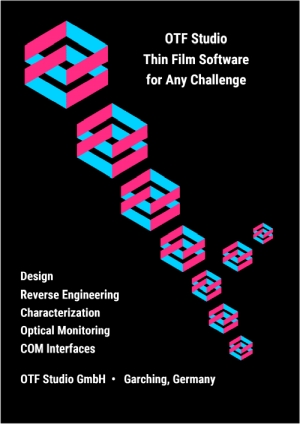
Thin Film Software for Any Challenge
-
OTF Studio® developed since early 2023, is a modern solution for the design, analysis, monitoring, and reverse engineering of multilayer optical coatings. The software is already well established in the industry and recognized for its rapid evolution, robust software architecture, and advanced capabilities.
-
Powered by a newly developed, highly effective computational framework, OTF Studio ensures both computational speed and stability in performance. Continuous innovation and integration of user feedback have quickly made it a reliable and leading tool for professionals in the optical thin-film field.
-
Learn more in Development history
-
Download OTF Studio booklet
-
Modern, fast, effective, intuitive, and user-friendly
-
Functionalities required for optical coating designers
-
Thin-film designs of any complexity
-
Highly effective state-of-the-art software solutions
-
Powerful and speedy optimization and synthesis algorithms; some of them, with incorporated machine learning (see OTF Studio videos on design).
-
Needle optimization, Gradual Evolution.
-
Deep Search synthesis algorithms incorporating machine learning elements.
-
Production-friendly design tools: Smart Brush algorithm and BoundTrap algorithm.
-
Multi-Start algorithms with machine learning and Jumps setting.
-
Flexible and reliable reverse engineering models.
-
Original and smart algorithms for characterization of monolayers (dielectrics, metal films, metal-dielectric composites, ITO).
-
Drude model, Drude + 1 oscillator model, oscillator models for characterization of monolaayers.
-
Easy import of measurement data from many spectrophotometers, ellipsometers, Excel files, and via drag-and-drop.
-
Spectral and angular plots; second Y-Axis, 2D and 3D plots, tooltips, different scales (linear, logarithmic, diabatic).
-
Simultaneous plotting in linear and optical‑density scales is supported.
-
Modern chart designer.
-
Templates. Import/Export of templates is supported.
-
Layouts.
-
Project management using standard operations (new, open, save, save as) available at Quick Access Toolbar or using a standard back-stage interface.
-
Modern ribbon interface and customizable layout using docking technology for panels and plots.
-
Special design options for ultrafast applications (dispersive mirrors, complementary pairs, double-angle method, pulse analysis, third order dispersion).
-
Color design and evaluation (videos):
-
-
color diagrams (CIE xyz 1936, UCS 1976, Lab, c*hs(uv), H°LC),
-
color evaluation (chromaticities, tristimulus, CIE YU´V´ 1976, CIE YUV 1960, Hunter Lab, CIE Lab, CIE Luv, CIE H°LC, CIE C*hc(uv))
-
color differences (CIEDE 2000, CIE 76, CIE 94 (graphic art), CIE 94 (text files), CMC 1:1 (1984), CMC 2:1 (1984),
-
color patch,
-
color specifications (formulated as color differences ΔE<a or as a convex polygon)
-
Monte-Carlo analysis of colors,
-
freeze colors,
-
compare colors,
-
multiple Color Evaluation panels,
-
dominant wavelength, complementary wavelength, excitation purity,
-
yellowness,
-
color correlated temperature,
-
Delta u, v (Duv),
-
Color Rendering Index (CRI),
-
linked color targets,
-
color evaluation in reverse engineering mode.
-
-
-
Electric field optimization (see demo-video). Electric field distribution, estimation of LDT.
-
Integral values; comparison of integral values related to different designs.
-
Integral values based on measurement data.
-
Stress and thickness optimization (see demonstration videos).
-
Robust synthesis.
-
Advanced materials (thickness dependent optical constants, mixtures, gradient layers).
-
Rugate synthesis.
-
U- and g-values according to EN 410/673, NFRC Winter, and NFRC Summer.
-
Design optimization with respect to IGU characteristics.
-
Operations with measurements: Compare, Append, and Combine.
-
Multi-scan measurements: import and processing.
-
Batch measurements, batch processing, and visualization (1D, 2D). Videos.
-
Multi-Environments: analysis and design. Supports a wide range of advanced use cases, including mass‑production coating design, birefringent optics, nonlinear multilayers, thermal‑response modeling, dome‑geometry coatings, lens-related designs.
-
Monte-Carlo analysis, Yield analysis, Worst-Case performance.
-
The interactive analysis tool operates for all active plots and panels in the layout.
-
Interactive Admittance diagram including iso-reflectivity curves.
-
Expressions and linked expressions.
-
Spectral and Angular targets. Support bidirectional Spectral ↔ Angular transformations.
-
Concept of the Machine and automatic generation of monitoring strategies. The Strategy Generator can optionally use monitoring wavelengths from the defined set.
-
Generation of monitoring spreadsheets with a large number of parameters.
-
Special design and analysis options for Multi-QWOT narrow bandpass filters. Advanced settings enabling randomization with respect to design and target parameters.
-
My Catalog feature for layer materials, substrates, and light sources.
-
Non-parametric model for complex characterization problems.
-
Features specific for XUV and X-ray applications: Roughness evaluation using the Névot–Croce model, Grazing angle, Re(n) as delta specification.
-
Optional synthesis of symmetrical designs, with symmetry defined relative to the central point of the design, is supported.
-
Reverse engineering of stacks - assemblies of substrates with optional coatings on their surfaces. Typical use case: double‑sided optical elements.
-
Preprocessing of measurement data including smoothing, cutting non‑informative or noisy spectral regions, and removing non‑physical values.
-
Double context concept: Simultaneous work in two modes: AS and OM, OM and AS, OM and OM.
-
Reports including plots directly to Word, PDF, Excel, or to print.
-
Tabulate feature
-
OTF Studio provides external access to almost all its algorithms and parameters through powerful COM interfaces.
 Explore our